
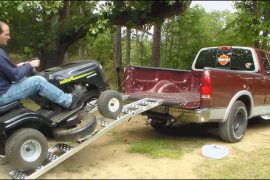
Riding a lawn mower makes it easier to complete most mowing tasks, in considerably less amount of time and with minimum effort. Both homeowners and professionals use a variety of riding mowers to perform the chores of mowing.
It is often essential to carry a riding lawn mower on a trailer, especially for those who have commercial properties. Hence, to minimize damage to the equipment, the mower must be properly loaded and secured on the trailer for travel.
I guess you are here to get a proper guideline on transporting a riding lawn mower. For you, we’ve come with this step-by-step guideline.
So, let’s talk about how to transport a riding lawn mower.
In this content you’ll learn:
How To Transport A Riding Lawn Mower
It is very difficult to load your lawn mower onto a vehicle without enough preparations. Moreover, loading the lawn mower will also cause a number of problems without sufficient adjustments.
That’s why you will need to adjust your lawn mower correctly. After you prepare your lawn mower carefully, then you can load your lawnmower into a moving truck by following some simple steps.
Preparation
First of all, you have to completely drain the gas tank and oil tank of the lawn mower. That’s because an oil or gas leak from your lawn mower can become very dangerous while transporting.
Secondly, you have to clean your lawn mower properly. Any kind of grass or dirt in your lawn mower should be wiped off.
Thirdly, remove all the blades and attachments of your lawn mower and carefully store those. You have to make the lawn mower as light as possible.
Lastly, before putting the lawn mower in the driving truck, remove the spark plug of your lawn mower.
Equipment
To transport your riding lawn mower efficiently, you will need the following equipment.
- Trailer with ramp
- Ratchet straps or rope
- Wheel chocks or wood blocks


Steps To Follow
These are the essential measures that you should take when transporting a mower to securely transport your lawn mower.
Step 1
First, you need to connect the trailer on the back of a vehicle with a loading ramp. Then, lock the trailer securely with the hook of the trailer on the vehicle and attach security chains.
Step 2
Second, place the trailer and the vehicle in a way so that they are on a level surface, Now, lower the trailer loading ramp to adjust it with the vehicle. If required, move the trailer so that the top of the gate can be placed perfectly on the floor.
After that, put wooden chocks or blocks under the trailer wheels to make the trailer more stable.
Step 3
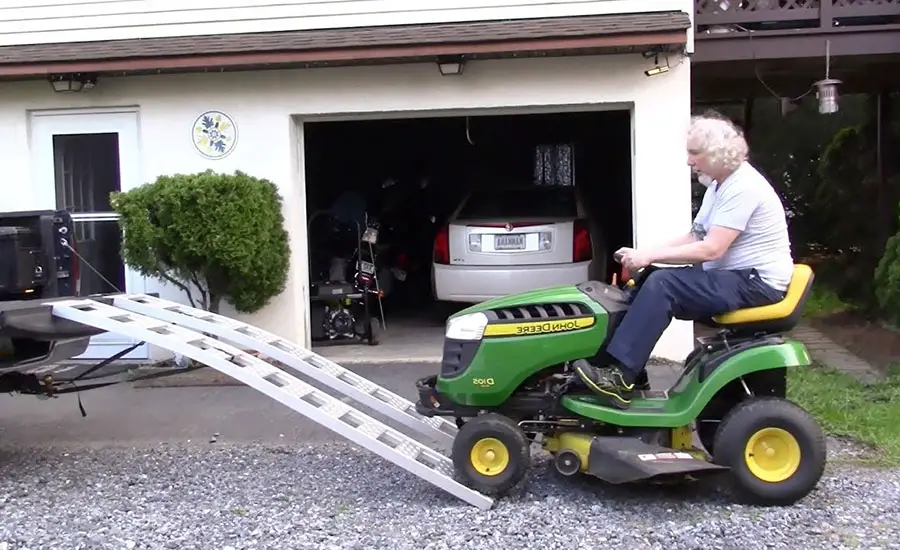
Third, get on to your lawn mower and raise the lawn mower deck. Next, drive the lawn mower carefully to the ramp. Try to equally balance the weight of the lawn mower on the trailer platform.
Step 4
After getting onto the transport vehicle, fully stop the lawn mower. Then, lower the lawn mower deck. Furthermore, turn off the spark plug. Lastly, put your lawn mower in gear so that it prevents the lawn mower from rolling away.
Step 5
Next, prevent the movement of the lawn mower with a chock so that it can restrict movement during shipping.
Step 6
Now, use the ratchet straps or rope to close the hood of your lawn mower so that while transporting the air pressure will not open the hood.
Step 7
Finally, lock the lawn mower’s hood and seat of the mower with ratchet straps or rope and make sure that you attach the ratchet straps on the sides of the trailer.
In addition to that, you can also place ratchet straps on the front and rear of the lawn mower so that it’s secured properly.
Conclusion
In conclusion, we can see that the steps of how to transport a riding lawn mower are not so difficult. All you have to do is make some preparations for your lawn mower. Then, you will need to follow the above mentioned steps carefully.
And always be cautious when you implement safety precautions. Thus, you can easily transport a riding lawn mower.